
Breath Conductor
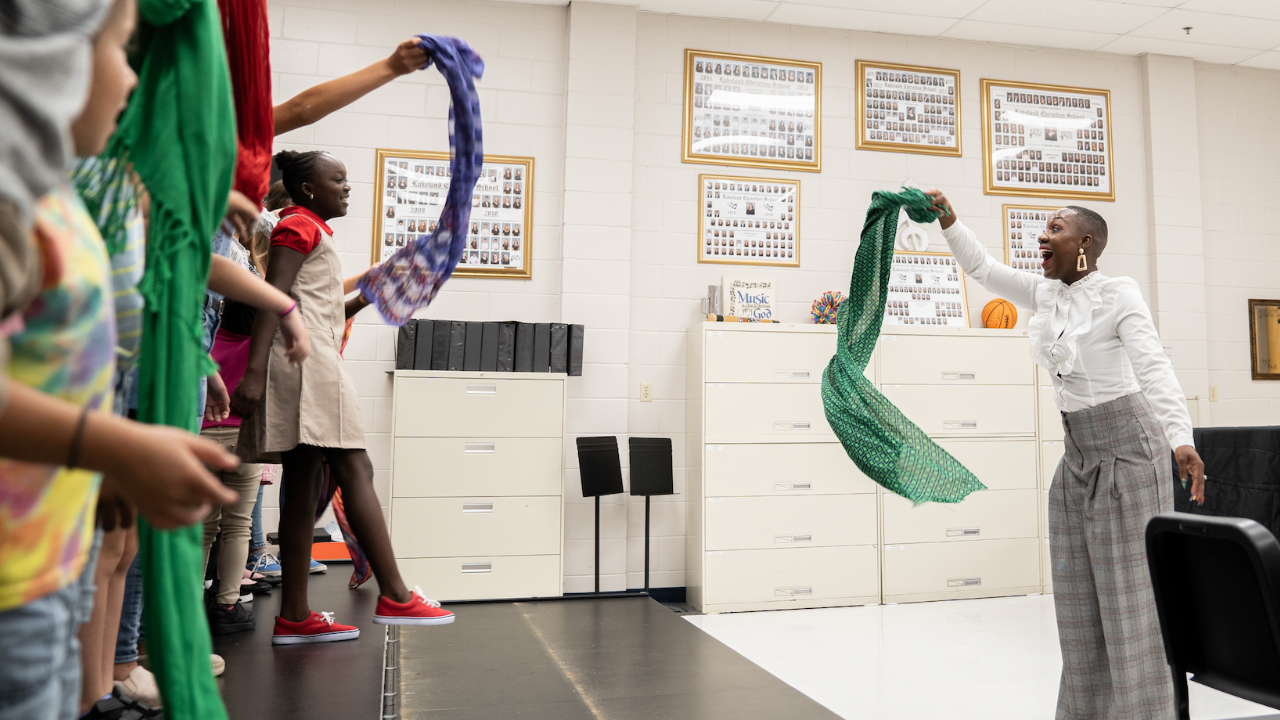
When students are dysregulated, the breath is often the fastest and most effective tool you can use to reset. Breath Conductor is a structured yet playful activity that helps students practice self-regulation and leadership through music and movement.
Here’s how it works:
- Choose one student to be the Conductor, while the remaining students act as the Performers.
- Direct the Conductor to lead a series of breathing exercises, such as:
- Inhale for 4 counts, exhale for 8 counts
- Inhale through the nose, exhale through the mouth
- Short, quick breaths vs. long, steady breaths
- Once the group is comfortable with the breathing patterns, try adding sounds or instruments. The Conductor can direct Performers to:
- Copy a simple melody
- Repeat a sustained note or short pattern on an instrument
- Add voice to the breath pattern they conduct (ex. "ooo," "ah," "mmm")
- Repeat these steps after choosing another Conductor.
Variations:
Level Down:
- Adult-led first: Conduct the first few rounds yourself so everyone learns the routine.
- One pattern only: Stick to a single predictable pattern (example: Inhale 3, exhale 5) for 4-8 cycles.
- Seated version: Keep everyone seated with hands on belly to feel the breath—less chaos, more regulation.
- Copy-me cues: Instead of choices, the Conductor uses only “Breathe in” / “Breathe out” gestures.
- Short + successful: Do a 30–60 second reset and end while everyone is still engaged. Slowly lengthen how long you do the activity for.
Level Up:
- Multiple ensembles: Break into small groups or pairs, each with their own Conductor.
- Silent Conductor: The Conductor can’t talk—only uses hand signals (up = inhale, down = exhale, hold = pause).
- Tempo control: Repeat the same pattern (ex: Inhale 3, exhale 5), but ask the Conductor to “speed up / slow down” the breathing rate in live time like a real maestro
- Leadership challenge: The Conductor must lead the group from “high energy” to “calm” using only breathing and simple cues.
- Dynamics: Add volume cues (ex. silent inhale, soft exhale, medium hum, big “whoosh”).
- Instrument Swap: Half the group uses voice (“mmm/ooo”), half uses instruments.
- Circle Up: Gather in a circle. One student becomes the Conductor and models a single breathing round (ex. Inhale for 2, exhale for 4); the Performers copy it. Then rotate to the next person in the circle, who leads a new breathing round for everyone to follow (ex. Inhale for 4, exhale for 4). Progress around the entire circle.
